The best prayer request plugin for your church is not the one with the nicest form. It is the one that answers seven technical questions correctly, because a prayer request plugin for WordPress quietly decides where personal data sits, which outside scripts load next to it, and what happens after someone clicks send.
We make one of the options below, so read this with that in mind. Every fact here comes from the vendor's own documentation, checked in September 2026. We have not ranked the list, and you should not trust a list that does, because a church running a 24/7 chain and a church that wants one wall page are not solving the same problem.
Start with the complete guide to church prayer request management if you have not designed your workflow yet. Otherwise, read on.
Seven checks before you pick the best prayer request plugin
Run every candidate through these seven checks. Most feature lists answer only four of them.
Checks 1 to 3: where the data goes
- Where does the request text live? Either in your own WordPress database, or on the vendor's server. Prayer requests routinely contain health information, and the GDPR treats health as a special category, so this is a data protection decision rather than a preference. The ICO's conditions for processing special category data explains the standard.
- What third party scripts load on the form? Google reCAPTCHA is the common one, and it loads Google code on the page and sends visitor data to Google. Therefore it belongs in your consent banner and your privacy notice if you are inside the EU.
- Can a volunteer review without Administrator rights? In WordPress, permissions are called capabilities, and a role is a bundle of them. Administrator is the bundle that includes installing plugins and creating user accounts, so a reviewer should never need it.
Checks 4 to 7: what happens next
- How many moderation states are there? A single approve or reject pair is not enough, because a request can also be private, team only, answered or declined.
- Does anything delete itself? Retention means old requests disappear on a schedule instead of when someone finally remembers.
- What comes out on export? Either CSV or JSON, which are plain text formats any other system can read, or nothing at all.
- Are prayer campaigns handled? A 24/7 chain is time slot booking rather than request handling, and almost nothing in this category does it.
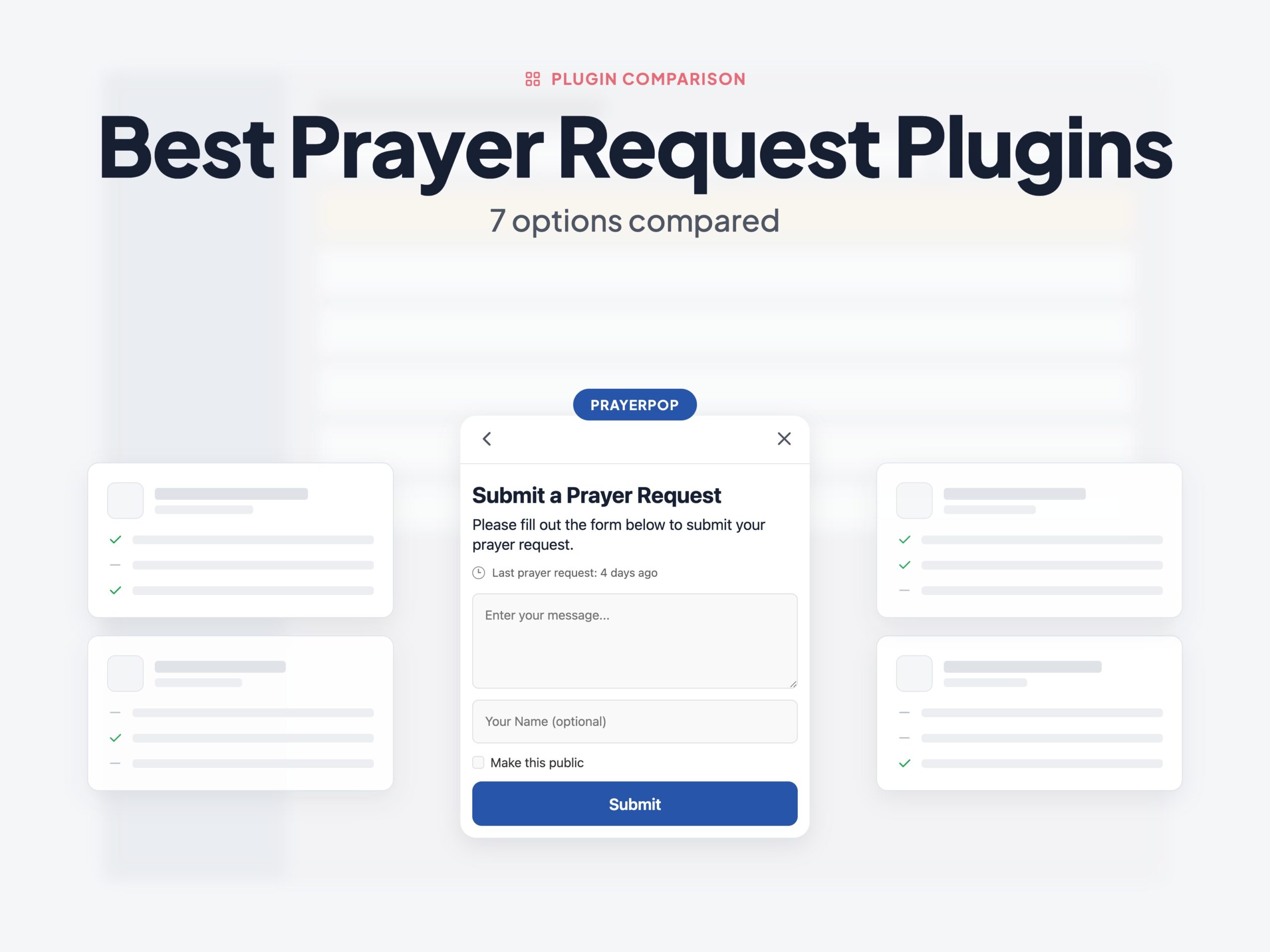
The comparison between prayer request plugins
Every plugin here handles this part. However, the answers differ on where the data goes and what loads beside it.
| Plugin | Price | Data lives | Volunteers can review without admin | Styling without code | Editor |
|---|---|---|---|---|---|
| PrayerPop | Free, Pro 49€ lifetime access | Your database | Yes | Colours, radius, fonts, Branding setup in 5 minutes. | Shortcode, Divi, (Elementor, gutenberg coming) |
| Intercessor | Free | Your database | Yes | Block editor controls only | Gutenberg block |
| Prayer Engine | $99 one time | Plugin plus web app | Not documented | Appearance, icons, colours in settings | Not documented |
| Church Admin | Free, premium ~$50/yr | Your database | Yes, suite wide | Not documented | Shortcode |
| Kingdom Prayer Wall | Free, monthly premium | Your database | Not documented | Their team does it for you | Not documented |
| GoPray | Free | Your database | Not documented | Button colour only | Shortcode |
| Nucleus Prayer | Free tier, paid upgrades | Vendor servers | Vendor accounts | Not documented | Launcher embed |
The comparison: everything after the request arrives
Collecting is the easy half. This second table covers the stages most plugins stop before, and it is where the list stops being close. Because we build one of these, check the cells yourself. "Not documented" means the vendor publishes no answer, not that the answer is no.
| Plugin | Sender notified | Answered and testimonies | Deletes on a schedule | Export file | Visitor chat | Campaign slots |
|---|---|---|---|---|---|---|
| PrayerPop | Yes | Yes | Yes | WordPress export | Yes, in Free | Yes |
| Intercessor | Not documented | Not documented | Not documented | CSV in and out | No | No |
| Prayer Engine | Yes, on "I prayed" | Not documented | Not documented | Not documented | No | No, calendars only |
| Church Admin | Not documented | Not documented | Not documented | Not documented | No | No |
| Kingdom Prayer Wall | Not documented | Not documented | Not documented | Not documented | No | No |
| GoPray | Yes, email alerts | No | Not documented | Not documented | No | No |
| Nucleus Prayer | Not documented | Not documented | Not documented | Not documented | No | No |
Two columns decide most purchases. First, deletes on a schedule is the difference between a retention policy you wrote and a retention policy that runs. Second, campaign slots is the difference between a 24/7 chain and a shared spreadsheet.
PrayerPop
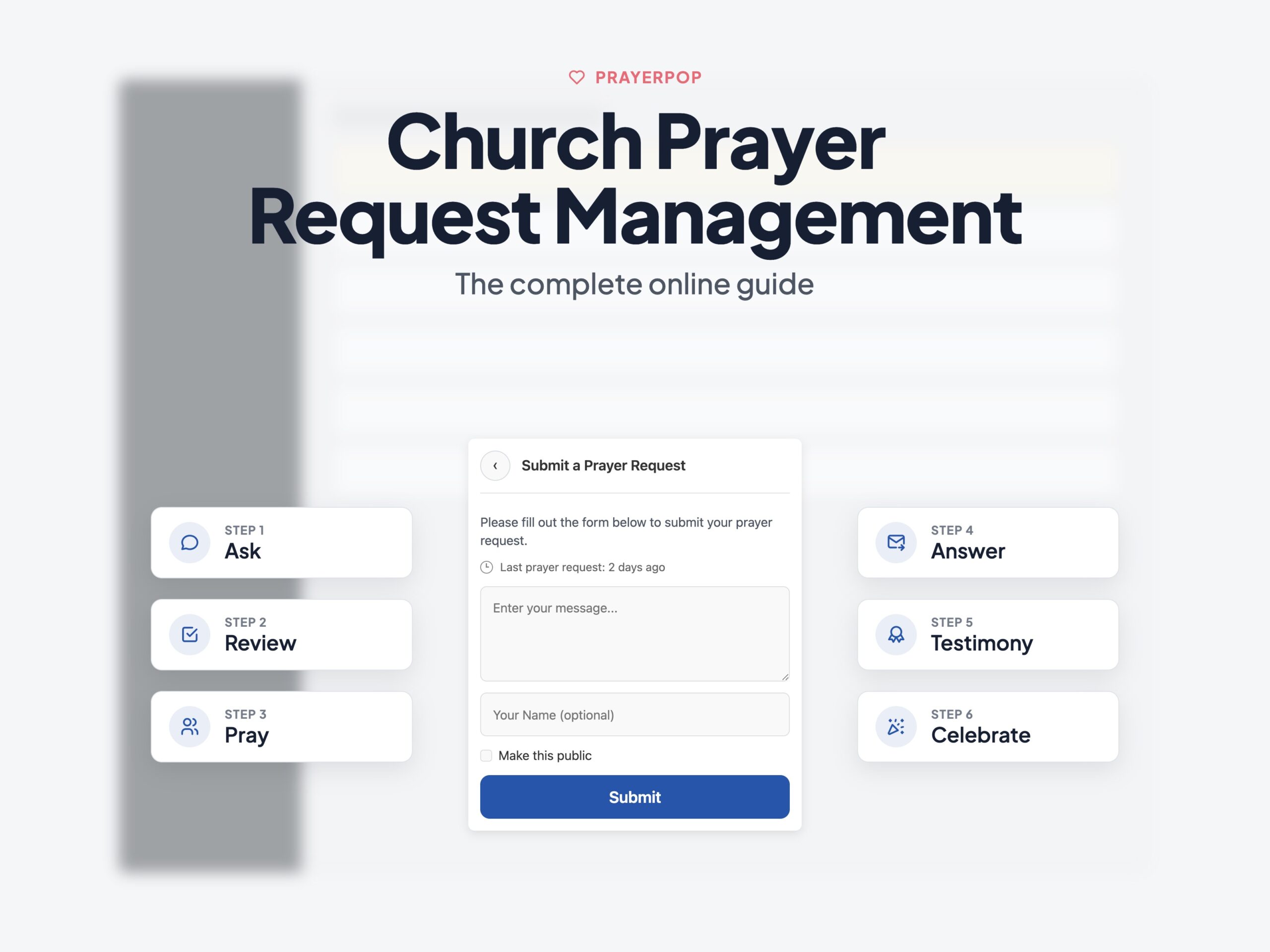
Covers all six stages: ask, review, pray, answer, tell, delete.
A bubble on every page collects prayer requests and testimonies. Each request then enters a moderation queue, which is a screen where the request sits in a named state until a reviewer moves it. Approved requests feed a public wall, and answered requests can be marked, followed up by email, and turned into a testimony with separate consent.
The technical parts, in plain terms
- Spam handling without external scripts. A honeypot is a hidden field that only automated bots fill in, while rate limiting caps how many submissions one visitor can send in a period. Both run on your own server, so no Google code loads on the page and there is nothing extra to declare in a consent banner.
- Storage in your own database. Every request, testimony and chat message is a WordPress record, stored the same way a page is stored, so it exports with the rest of your content.
- Retention limits and personal data export. Retention means the site deletes records automatically after a period you set. Export produces a file of one person's data on request, because that is what a GDPR access request asks for.
- A prayer team role (Pro). A role is a bundle of named permissions, and this one contains the prayer screens and nothing else. As a result, a volunteer never touches plugin installs or user accounts.
- Campaign slots (Pro). Each prayer hour becomes a bookable slot, with confirmations, calendar links, QR codes and reminders. Nothing else in this list does it.
- Chat in the free edition. A shared inbox for visitor conversations, stored in the same database.
Intercessor
Covers ask, review, pray and part of publish.
Free, from the WordPress.org directory. It provides a prayer form block for the block editor, anonymous submissions, private requests for a pastoral team, a public wall with an "I prayed" counter, admin moderation, a profanity filter, duplicate detection, CSV export and import, prayer reports, and its own roles and capabilities.
However, the form depends on Google reCAPTCHA. Google scripts therefore execute on the page where people type health information, and that transfer needs a line in your privacy notice and an entry in your consent banner inside the EU. There is also no chat, no time slot campaigns, and no documented automatic retention.
Prayer Engine
Covers ask, review and publish.
$99 one time for a single organisation licence, sold as a plugin plus a web app. It builds prayer walls, sends moderation emails on submission, and notifies the sender when someone marks the request as prayed for. In addition, it includes prayer calendars and online prayer sessions.
Plugin plus web app means part of the data path runs on the vendor's servers, so ask which part before you buy, because the answer decides whether check 1 passes. There is no free edition to test with, no chat, and no slot signups.
Church Admin
Covers ask and review, inside a larger system.
A church management suite with a prayer request module attached. Requests can be public, or private and visible to the pastoral team only. The core plugin is free, while the premium tier costs around $50 per year. Everything stays in your database.
The module is one feature among dozens, so the prayer workflow stops at collect and review. Adopting it also means adopting the suite's way of handling members, services and rotas.
Kingdom Prayer Wall
Covers ask, review and publish.
Built around members praying for each other on your site. A free tier covers the basics, while a premium tier runs on a monthly fee. Request management, campaigns and chat sit outside its scope.
GoPray
Covers ask and review.
Visitors submit a request or pray for an existing one, and administrators moderate from the dashboard. It also sends automatic email alerts to the sender. However, privacy controls are basic, there is no testimony workflow, and there are no campaigns. It is the smallest install here, which is the point of it.
Nucleus Prayer
Covers ask and publish.
A hosted tool that attaches to any church website through a launcher script, with a prayer wall and a personal prayer mode. It works on any platform, not only WordPress. The basic prayer feature is free. Third party directories list paid upgrades from around $9 per month, and the launcher belongs to a wider platform sold at a monthly rate, so treat the free label as a tier rather than the price.
Because the request data sits on the vendor's servers rather than yours, check 1 fails by design. If a hosted service is acceptable, a Google Form into a private spreadsheet does the same collection job with no plugin at all, although you get no wall, no moderation states and no testimonies.
How to choose the best prayer request plugin
Three questions, in this order.
Where must the data live? If prayer requests must stay under the church's control, then the shortlist is the plugins that store records in your own database. That removes Nucleus, and it puts a question mark on Prayer Engine until the vendor tells you what the web app holds.
What happens after the request arrives? Count the stages you actually need. If you stop at a wall, most of this list qualifies. However, if you run prayer seasons, 24/7 chains or mission trips, slot booking becomes the deciding feature and it exists in only one place here.
Free or paid? Intercessor, GoPray, Kingdom's free tier and Church Admin's core cost nothing. PrayerPop Pro and Prayer Engine are both single payments with no renewal, while Kingdom's premium tier and Nucleus's upgrades are monthly. Finally, check current prices on each vendor's site, because this page will age.
So which is the best prayer request plugin?
There is no single answer, and any comparison that hands you one is selling something.
The seven checks give you the answer instead. If checks 1, 2, 3, 5 and 7 matter at your church, meaning the data stays on your server, no third party script sits beside it, volunteers work without Administrator rights, old records delete themselves, and prayer seasons need slot booking, then PrayerPop is the only option here that passes all five. That is what we built it for. But if your requirements stop earlier, buy something smaller.
See how PrayerPop handles each stage or ask us directly. We would rather talk you out of the wrong tool than into the wrong plugin.