
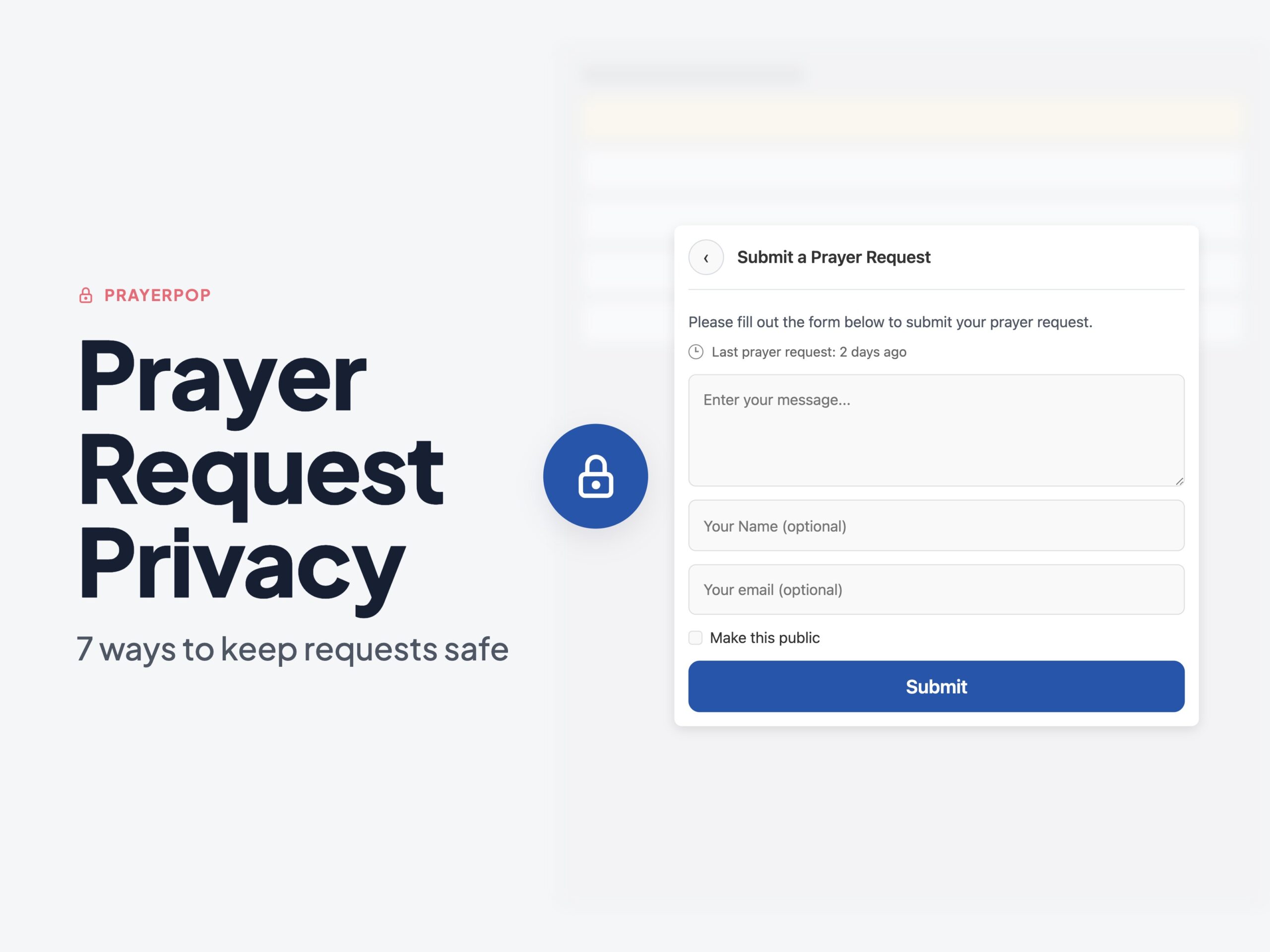
Prayer Request Privacy: 7 Ways to Keep Requests Safe on Your Church Site
Think about what people actually write in a prayer request. Health scares. Marriage trouble. A lost job. A son or daughter far from faith. An addiction they have told no one else about.
This is some of the most personal text a person will ever type into a website. And on many church sites, prayer request privacy is an afterthought: the text is collected by a form that quietly hands it to an advertising network, or a chat widget that streams every word through a third-party server before your team ever sees it.
PrayerPop was built on a different assumption: what visitors share with your church should stay with your church. Here are the seven ways it protects prayer request privacy, all shipping today.
1. Everything stays on your own server
When someone submits a prayer request or testimony through PrayerPop, it is saved as a post in your WordPress database. When a visitor starts a chat conversation, the conversation is stored in tables on your own server and managed from your own admin area. No external chat service, no inbound-email processor, no third-party script loaded inside the popup. The conversation between a visitor and your team never touches anyone else's infrastructure on its way.
2. The details are engineered for privacy
Prayer request privacy isn't just a hosting location — it's in the design details:
- The browser cookie that reconnects a returning visitor to their chat contains only a random token. Your database stores a one-way hash of it — never the raw credential.
- The Prayer Lottery Wheel rate-limits draws using a salted hash derived from the visitor's IP address, kept for up to one minute. It stores no visitor prayer history and no raw IP address.
- Campaign signup retention can anonymize personal fields while keeping the aggregate totals your reports need.
3. Spam protection without a CAPTCHA
Most WordPress forms lean on Google reCAPTCHA to stop bots. That means Google scripts and cookies load on your church's pages, and every visitor — including the ones typing their hardest prayer — passes their data through Google on the way in.
PrayerPop takes another route. Spam protection is built in and invisible: a honeypot field, a minimum submit time, per-IP rate limits, and cooldowns between submissions. Legitimate visitors never see a checkbox, never solve a puzzle, and never talk to a third party. Bots still don't get through.
4. Retention controls that clean up on your schedule
Prayer request privacy has a time dimension too: data that no longer needs to exist shouldn't exist. PrayerPop lets you set how long submissions and chat conversations are kept, and chat conversations are permanently removed after the retention period you choose, counted from the last activity. Closing a conversation doesn't delete it; the retention clock you set does.
5. WordPress privacy tools, built in
If your church is in the EU, the GDPR question is not hypothetical, and prayer request privacy needs tooling, not promises. PrayerPop works with WordPress's built-in site privacy features:
- Export and erase personal data.
Tools → Export Personal DataandTools → Erase Personal Datafind or erase a person's chat records, campaign signups, and follow-up email data when they ask. - Privacy policy text. PrayerPop adds its description to WordPress's Privacy Policy guide, so writing your policy page is a copy-paste job.
6. Submitters stay in control
When submitter receipts are enabled, submitters get a secure link to remove their own request within 10 days — no email to the office required. And answered-prayer follow-up emails stop after 60 days. The follow-up blesses; it doesn't haunt.
7. The honest list of what does leave your server
Trust requires specifics, so here is the complete list. Prayer request and testimony notifications go to the email addresses you configure. Chat notifications go to your team and, when someone left an address, back to that visitor. If you enable AI moderation in PrayerPop Pro, submissions are checked through OpenAI using your own API key — off by default, and your team always makes the final call. That's it. No analytics, no trackers, no embedded widgets.
Designed in Europe, for churches everywhere
PrayerPop is made in Estonia. We built it so a church in Tallinn, Berlin, NY, San Fransisco or Barcelona can run a real prayer ministry — requests, testimonies, chat, campaigns — without wiring their congregation's personal data into advertising networks or overseas chat platforms.
Your website can be the safest place in your members' week to say "please pray for me." That is not a feature list. It is the whole point.
Want to see the privacy controls for yourself? Browse the PrayerPop feature list or read through the public demo wall — and if you have a GDPR question we haven't answered, ask us directly.